“WE NEEDED A MACHINE CAPABLE OF DIGGING THE 4M WIDE TRENCH EASILY AND SAFELY.”
Whilst much of Spain enjoys a regular and plentiful supply of water, the municipality of Huerta located in the province of Salamanca, Castile and León, Spain is adding a series of new pipelines to assist the farming community in the region to prosper even under demanding weather conditions.
The project is part of the Recovery, Transformation and Resilience Plan (PRTR) and will see work carried out over a 20-month period. The project's main objective is to optimise water use and reduce energy consumption for irrigators by constructing a new, higher-altitude water intake infrastructure, thus eliminating the need for current pumping systems. Two large-capacity reservoirs will be built and automatically filled, connected by main pipelines that will distribute water to the aforementioned sectors.
Furthermore, the project incorporates modern technologies such as remote monitoring systems and infrastructure automation to improve the management and control of irrigation water. The project is also expected to reduce pollutant emissions by eliminating the use of diesel-powered pumps, thereby contributing to climate change mitigation. The project to install over 45km of heavy-duty fibreglass reinforced plastic pipe measuring from 1.6 to 2m in diameter has been won by three of Spain’s most experienced water infrastructure companies, Espina Obras Hidráulicas, Construcciones y Obras Valbuena, and Rover Infrastructures. Part of this team is Semask SA from Alcarrás who have a rich history in delivering complex earthmoving, construction and civil engineering projects throughout Catalunya and the wider region.
The highly fertile agricultural land is known across Spain for its ability to support crop growing with the fields being worked almost all year around.
Semak SA is a big user of Liebherr equipment. Excavators up to 120 tonnes, dozers up to 54 tonne and a range of wheeled loaders dominate the fleet. It is some of the largest items in the fleet which have been deployed to this project to ensure its efficient progress.
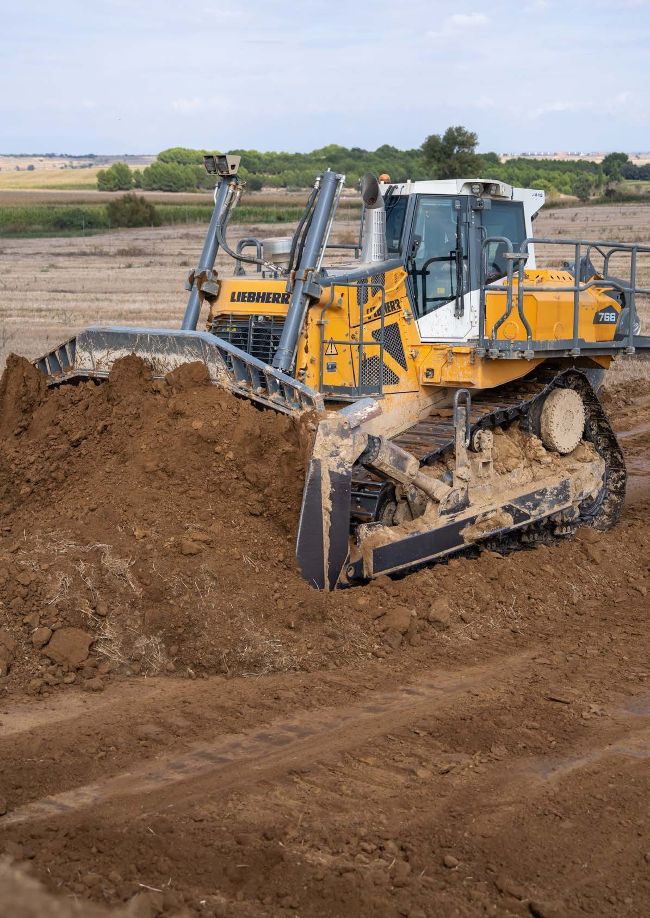
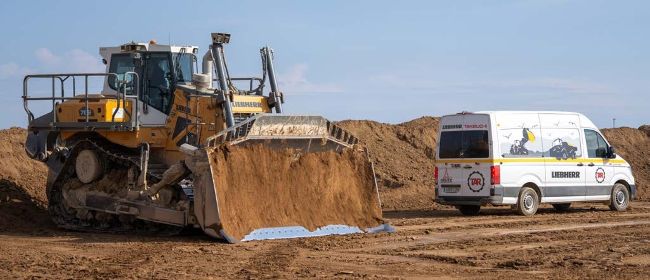
Preparing the spread for the pipeline to go through involves the stripping of the valuable topsoil to expose the sub soils below. With the spread measuring around 25m wide, Semak has deployed its largest dozer to undertake the work. The Liebherr PR 766 has an operating weight of 54 tonnes and carries a Semi-U blade with a 13.6m3 capacity. Whilst not required on this part of the project, the dozer sports a large, single-shank ripper to the rear. Working from the centre of the spread, operator Ilie Buzes pushes the hard material to the edge of the ground the project has ‘rented’ from the landowner. Once he has completed five or six passes pushing soil one way, he quickly spins the dozer around and clears the remaining material onto the opposite side of the spread. Whilst the 422hp dozer may seem to be overkill for this project, the speed at which it strips such a large volume of material means it can easily stay ahead of the excavation and pipelaying teams.
“THE
SPEED
AT WHICH IT STRIPS SUCH A LARGE VOLUME OF MATERIAL MEANS IT CAN EASILY STAY AHEAD OF THE EXCAVATION AND PIPELAYING TEAMS.”
While the big yellow Liebherr dozer stands out in the greenery surrounding it, just a few hundred metres away Semak SA’s Liebherr R 9100 excavator also makes a bold statement.
Not your typical machine on a pipe laying project, the R 9100 is usually found on mining and quarrying projects throughout the region. “We needed a machine capable of digging the 4m wide trench easily and safely.” Semak commented. “We also have issues with the ground conditions too which has meant we needed a machine with plenty of digging ability too.” Whilst the fields are ideal for growing crops thanks to over a metre of fertile topsoil, this gives way to a more clay-like material for another metre before it turns into a hard and abrasive mudstone.
With an operating weight of just over 105 tonnes, the R 9100 is powered by a 24 litre, V12 Liebherr diesel engine developing 757hp and was the first machine in Liebherr’s latest G6 generation of 100 tonne plus mining machines. Introduced to the market in 2009, the R 9100 has sold across the world into mining and quarrying operations and is well liked for its ability to work in tighter spots on site where larger machines couldn’t fit, or smaller machines couldn’t productively undertake the work. Semak’s machine is designed for their quarrying operations having Liebherr’s narrow, 600mm track pads fitted, and finds the softer underfoot conditions to be a little taxing as any wet spots in the soil are instantly found by the heavy machine allowing the tracks to sink slightly.
In its standard bulk excavation specification, the Liebherr is fitted with a 7.6m gooseneck boom, which is then coupled to a short, 3.2m stick. With its standard 7m3 bucket fitted, the maximum dig depth for the machine is just over 7m which is almost as deep as the trench required for the pipes to be installed. The R 9100 has also been outfitted with Leica MC1 machine guidance to assist in keeping the huge excavation for the pipes on the right level and always following the correct line. Bulking the softer material from the trench shows off just why the company has brought in this machine.
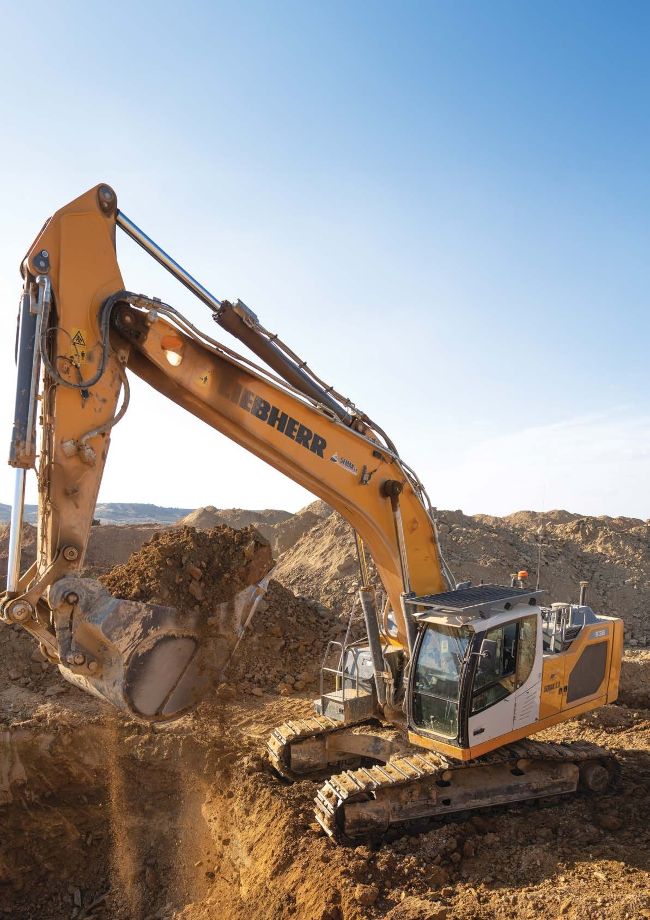
Although the cycle times look slow, the volume of material moved per bucket load is impressive. It is when the machine reaches the lower layers, and the ground gets harder that the machine’s digging prowess is brought to the fore. As the trench gets reaches its lowest point, entering the mudstone, the 560kN digging forces from the Liebherr helps it get through the material. Aided by the accurate Leica system, the operator takes his time to grade the rough material as best he can to ensure a relatively flat-bottomed trench.
A mile further up the spread, the pipeline doglegs around an existing road making the cut too small for the R 9100 to undertake. This section is being excavated by a smaller Liebherr R 938 G8 weighing around 40 tonnes. A competent excavator in its own rights, R 938 G8 had found a hard pocket of mudstone and was working very hard to get through it. The R 938 G8 was slightly mismatched with its attending dump truck to remove the material as it was working with one of the company’s Terex TR60 rigid dumpers. With a 60 tonne capacity, the venerable Terex was having an easy time of it on this part of the project!
Following close behind, the pipelaying team were blinding the base of the trench with a granite dust to give the pipework a firm and stable bed to sit on. Once the pipes were installed a Komatsu PC210 backfilled around the pipe with more of the granite before the excavated spoil is placed over the top. The final dressing of reclaimed topsoil will be placed and dressed ready for next year’s growing season.