The UK Government has been pushing to upgrade power, water and communications networks for many years. With planning permission for both on and offshore windfarms increasing along with the development of more and more solar farms means there is a need to connect these power generating hubs into the existing network.
Traditionally much of this new cabling, piping or ducting work has been undertaken by excavators. If the new line is crossing open fields, this work would entail a wide swath of land being stripped with the material stockpiled ready to be replaces on completion. The excavators would then dig a trench with the product placed inside before it is sanded and then backfilled. Depending on the product being installed, the trench could be open for days or weeks resulting in large areas of open land having to be fenced off and secured. There is however, a perfect, cost-effective alternative which can put in 500m plus of product per day, sanded, taped and covered over.
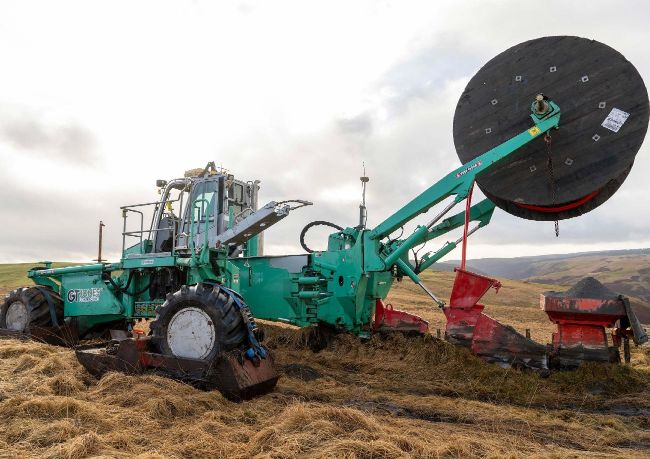
This alternative is cable ploughing and is the latest venture of South Wales multi-disciplinarians GT Jones Contracting. Already offering a range of civil engineering disciplines as well as plant hire and specialist fencing, masonry and landscaping works, the leap into cable ploughing and trenching was seen as the ‘next logical step’ according to Managing Director Gareth Jones. “We had the opportunity to buy the entire ploughing and trenching fleet from ATP, a company relatively local to us. Along with a new tracked Tesmec trencher which is ideally suited to a variety of urban trenching projects, we bought a full Foek cable ploughing outfit.”
Manufactured in Germany by Walter Föckersperger GmbH, a company with over 65 years of cable ploughing history. The GT Jones ploughing kit comprises of two main pieces of equipment, the FSP22 plough tractor and the FWF92 winch tractor, both of which are supported by a new Mastenbroek gravel tractor and a series of Takeuchi and Volvo excavators.
With the capability of pulling in product in excess of 300mm diameter depending on the ground and plough set-up, the variety of product the combination can quickly and effectively install makes it a very versatile outfit.
The 18 tonne plough tractor sits on four, equal-sized wheels, each of which sit on the end of independently movable legs allowing it to traverse a wide range of terrain. When in pulling mode, the wheels are strapped into a set of metal skids allowing the machine skate over the ground. Fully remote controlled or operated from the cab, the FSP22 is connected to the FWF92 winch tractor via a heavy-duty cable which can be doubled up to give a maximum pulling force of 180 tonnes with a single pull being 90 tonnes. The winch tractor secures itself to the ground using a large hydraulically operated spade at the rear and with can sit at as far as 100m away from the plough allowing it to be pulled a good distance before it needs to relocate.
“YOU HAVE TO BE
FOCUSSED
ON SEVERAL THINGS AT ONCE OR YOU CAN EASILY GET
INTO TROUBLE.”
The plough tractor uses a small 74hp engine to power the hydraulic and drive system as almost all of the work is carried out by the FWF92 winch tractor with its slightly larger 554hp engine. Sitting on a long and wide set of rubber tracks, looking very similar to a modified tracked dumper, the winch tractor weighs in at almost 28 tonnes yet only puts out just 0.32kg/cm2 of ground pressure making it very effective over soft ground.
As the winch pulls the plough in a straight line, plough operator Stephen Riddell steers the machine using the hydraulically adjustable plough itself. “You have to be focussed on several things at once or you can easily get into trouble.” Stephen commented. “It is easy to lose your depth if you aren’t watching and that’s the same with traversing uneven ground; you have to be feathering the legs to put pressure on a specific side to make sure the product is being pulled in properly.”
One of the first jobs undertaken by the company was to install a new power cable across a remote mountain top in Mid Wales. The TripleX cable was wound on a large drum held up on the rear of the plough and fed into the ground as the machine was winched forward. Not only does the machine put the cable in the ground but with the Mastenbroek following behind feeding sand into the plough’s hopper it sands under, around and on top of the cable along with laying warning tape before the tapered plough allows the ground to fall back around the cable.
Once the cable was installed, the slightly disturbed ground was cleaned and flattened by a Takeuchi excavator following on behind. The project involved installing around 2000m of cable over some soft and undulating ground and was successfully completed in just a couple of days thanks to mainly forgiving ground and the ability to undertake long, straight pulls. “We can be very quick and cost effective on longer pulls.” Gareth commented. “If we had undertaken this job in the conventional manner, we could have been here for at least a month or more. Not only that, but the ground disturbance would also have been far greater resulting in the ground taking longer to recover. There would have been additional costs for fencing and site accommodation and also the risk of having to deal with far more inclement weather.”
The successful completion of the project then saw the outfit undertake a demonstration day near their Abergavenny head office where a select group of major utilities companies were invited to see the productivity of the kit in action. “We think we opened the eyes of several people at the event.” Director Ed Jones commented. “It’s easy telling people you can do a certain task in a certain time but actually showing them how we pull 200mm ducting in at a metre depth, uphill at a length of 100m in just 10 minutes is the way to change people’s perceptions very quickly.”
“WE CAN BE VERY QUICK AND
COST EFFECTIVE
ON LONGER PULLS.”