Over 80 years ago, in the early 1940s, Francesc Garcia Alonso, father of the Garcia brothers and current owners of the company, was already into aggregate production with dredging of sand from the local rivers. However, it was not until 1962, together with his brothers, that he founded the company we are talking about today. Since then, the facilities have been expanded and modernised until the current aggregates production plant was put into operation in 2005. Since then, and despite being one of the most modern in the sector, it has not stopped innovating and improving processes. Automation, as well as the reduction of emissions, are the main objectives set in order to be the most competitive while always respecting the environment.
The large quarry is located to the northeast of Barcelona and has the capacity to produce approximately 1 million tonnes of high quality granite material per year. Like many quarries in the region, their output consists of a range of crushed and screened sand and aggregates along with rock armour for local projects. The company has CE marking for aggregates processed for the manufacture of asphalt and concrete, as well as gravels and rocks for sea defence works.
Extraction operations in the quarry depend on the products being produced with several working benches being quarried at any one time to provide a perfect combination of materials. Most of the large and expansive fleet of machinery is sourced from Caterpillar dealer Finanzauto as it has been since they purchased their first, a CAT 950 wheel loader in 1972. From wheel loaders to hydraulic excavators, the CAT brand has been a prominent name within the fleet for decades with the company still using a 30 year old 229 excavator for breaking oversized material. It wasn’t until 1990 that the company added their first CAT crawler excavator, a 219, into the fleet as methods of working changed.
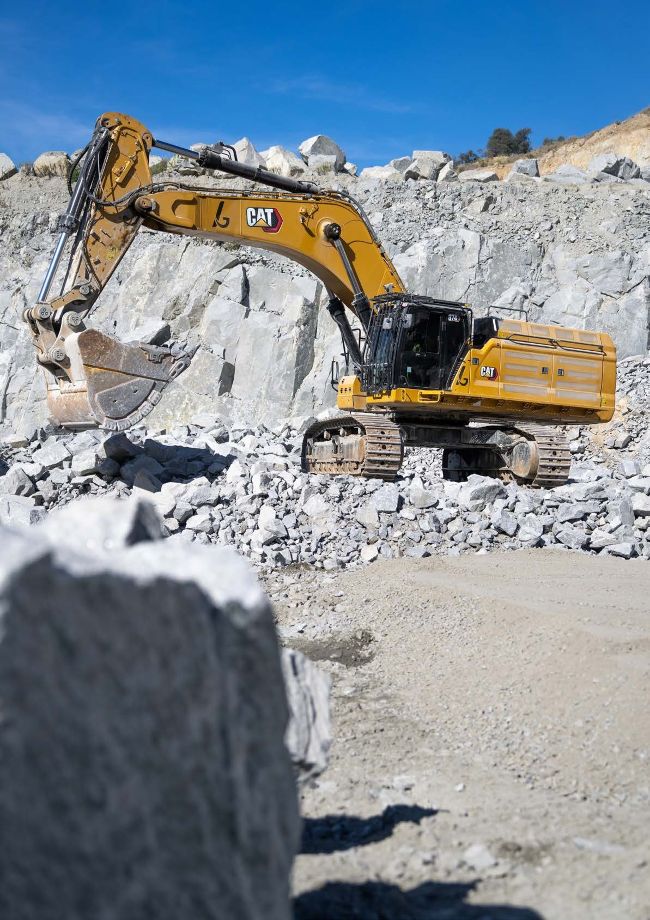
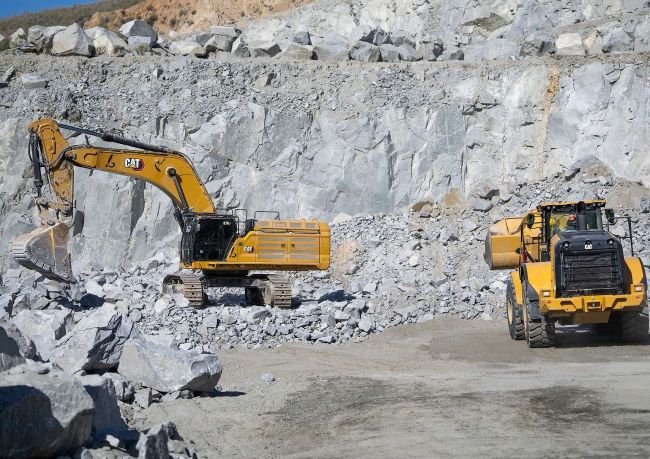
The more modern fleet of excavators is headed by a 74 tonne CAT 374 Next Gen excavator which has recently replaced a 2016 374F. This impressive machine handles much of the heavier operations in the quarry and spends much of its time on the lower benches opening up new areas of work. During our visit the excavator was working on a freshly blasted bench loading two of the company’s 771D haul trucks. Sitting on a shallow bench of material, the excavator uses the modern quarrying technique of working tall faces. Creating the bench allows the excavator to reach higher up the face, pulling material into a rock trap created in front of the tracks. The extremely hard material is hard on the excavators and trucks working on site resulting in higher levels of wear and tear. Despite the quarry’s best attempts at keeping benches level and clean for trucks, there is occasionally a need to sacrifice a few loads of granite sand to infill areas recently blasted to reduce damage to the expensive truck tyres.
“WE BELIEVE IN UNDERTAKING PREVENTATIVE MAINTENANCE TO ENSURE THE
LONGEVITY
OF OUR EQUIPMENT...”
As the 374 is setting up a bench on a fresh blast, the attending CAT 771D trucks are loaded further up the quarry with granite sand which is then tipped in front of the bench with one of the site’s CAT 966M XE wheeled loaders arriving to spread and level the material out. Three loads later and the sea of exposed, sharp rocks are covered in a blanket of material enabling the trucks to access the bench without fear of ripping a sidewall on their expensive tyres.
At the top of the quarry the company still utilise one of their oldest frontline machines to load out material. The CAT 349F has an operating weight of 50 tonnes and until the arrival of the newer machines, had performed a sterling job in excavating the extremely hard and abrasive material.
On a lower bench the latest excavator to join the fleet was working a tight area underneath an access ramp to the higher benches. The 38 tonne CAT 340, like the other large excavators sits on a heavy duty undercarriage fitted with double grouser pads. Working in a tight corner of the face, the new Caterpillar was loading a range of trucks with a variety of smaller, blasted material and rock which could be used in river and sea defences. A Cat 771D rigid truck is also working in the quarry, carrying material from the bench to the processing area, and although it is slightly large for the excavator, it is still loaded in a reasonable and timely fashion.
Much of the material leaving the various faces around the site eventually finds its way to the site’s 600 tonnes per hour crusher. Unlike many sites where manufacturers supply a specific product, the team at Arids Garcia took the decision in the early 2000’s to design and build their own system. The heavy duty system has been designed to be totally automated relying on a robust CCTV system and a range of sensors to warn of any potential issues within the plant. “We have built a very robust system here which has been very reliable and productive in the years it has been in operation”, Jaume Torreguitart commented. “We believe in undertaking preventative maintenance to ensure the longevity of our equipment whether it is the crusher and screeners or the plant undertaking the excavation works. The material is hard on everything here and we have to make sure we look after the equipment before it breaks and starts costing us money but more importantly, lost production.”