Caterpillar has never struggled to build machines. Steel, hydraulics and horsepower are its native language. What the company is now demonstrating is how intelligence is becoming a practical part of the jobsite rather than a future concept waiting in the wings. The latest announcements, unveiled at CES 2026, were less about the event itself and more about how artificial intelligence is moving closer to the machine, the operator and the work in front of them. Instead of analysing data after the shift ends, intelligence is increasingly embedded into equipment, supporting decisions as the job unfolds.
This shift builds on decades of experience. Long before automation became an industry buzzword, Cat® machines were already operating autonomously in mining environments where safety, consistency and scale matter above all else. Today, Caterpillar’s autonomous mining fleet has moved more than 11 billion tonnes of material worldwide, underlining just how mature that technology has become. Construction, however, is a different proposition. Jobsites are tighter, more variable and shared with people. Rather than attempting to transfer mining autonomy directly into construction, Caterpillar is adapting that experience to suit real-world site conditions.
That evolution was clearly articulated by Caterpillar CEO Joe Creed when outlining the company’s direction, positioning autonomy not as an end goal, but as a means of solving customer challenges more effectively.
“CATERPILLAR’S LEGACY OF INNOVATION IS ROOTED IN SOLVING OUR CUSTOMERS’ TOUGHEST CHALLENGES, AND THAT MISSION CONTINUES TO GUIDE OUR FUTURE.”
Joe Creed, Chief Executive Officer, Caterpillar Inc.
A key part of that strategy is bringing intelligence closer to the work itself. Through an expanded collaboration with NVIDIA, Caterpillar is embedding edge AI platforms directly into its machines, allowing them to process information in real time without relying on constant cloud connectivity. On construction sites where signal strength can be unreliable, that capability is critical. Machines will be able to interpret their surroundings, support operators and identify hazards as they happen, rather than after the fact.
One of the most immediately relevant announcements is Cat® AI AssistantTM . Built on Caterpillar’s Helios data platform, the system is designed to answer the everyday questions faced by fleet owners, technicians and operators and take action. By bringing together machine data, service history and technical documentation in a single conversational interface, the Cat AI Assistant aims to reduce downtime, speed up fault diagnosis and improve maintenance-focused decision making.
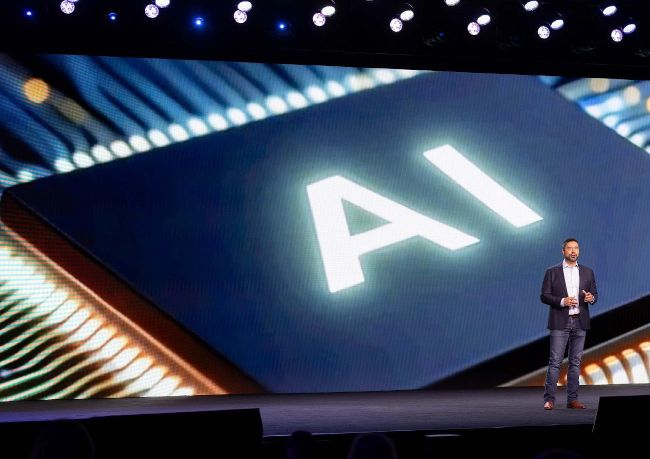
Joe Creed Chief Executive Officer Caterpillar Inc.
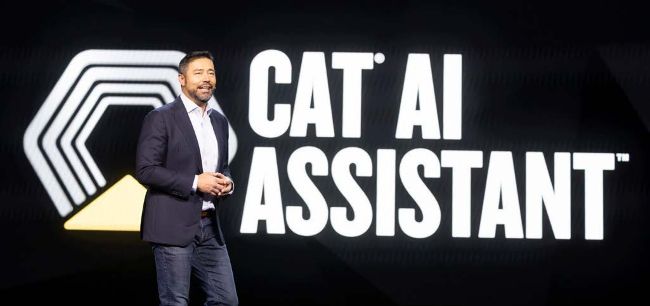
Announcing the launch, Caterpillar Chief Digital Officer Ogi Redzic highlighted the role the Cat AI Assistant will play in day-to-day operations, particularly in complex and remote working environments.
“CAT AI ASSISTANT IS A
MAJOR LEAP FORWARD
IN HOW CATERPILLAR SUPPORTS CUSTOMER SUCCESS THROUGH BEST-IN-CLASS DIGITAL SOLUTIONS, WHETHER THEY’RE WORKING FROM CORPORATE HEADQUARTERS OR AT A REMOTE JOBSITE.”
Ogi Redzic, Chief Digital Officer, Caterpillar Inc.
Crucially, the Cat AI Assistant is positioned as a support tool rather than a replacement for experience. Less experienced staff gain access to Caterpillar’s collective knowledge, while skilled technicians are freed up to focus on higher-value work. Cloud functionality, where the Cat AI Assistant will be embedded in Caterpillar applications and websites, is planned for early 2026. In-cab functionality is currently in development.
Autonomy within construction remains a sensitive subject, and Caterpillar’s approach reflects that reality. Construction sites change constantly, and people are always part of the picture. Rather than pushing fully autonomous machines overnight, Caterpillar is rolling out capability in stages through operator-assist features, semi-autonomous workflows and connected site systems. Excavators, loaders, dozers, haul trucks and compactors all feature in the roadmap, supported by platforms such as VisionLink and Cat Command that coordinate machines across the site rather than treating them in isolation. The objective is to improve safety, accuracy and consistency while keeping human oversight central.
Demonstrations of this approach have focused on realism rather than spectacle. A compact 306 mini excavator prototype equipped with the Cat AI Assistant and fleetintelligence tools highlighted how connected-site capability is not limited to flagship models. Elsewhere, Caterpillar illustrated how machines can share information, anticipate bottlenecks and adapt to changing conditions in real time. What stood out was how achievable it all felt, an extension of tools contractors are already using, rather than a leap into science fiction.
While CES set the direction, CONEXPO 2026 will be where that direction becomes tangible on the ground. Much of what Caterpillar outlined already exists within its current technology stack, particularly through Cat Command and its remote and semi-autonomous operating systems. These tools are already in use across construction, quarrying and mining where safety, access and consistency are critical.
The CONEXPOCON/AGG 2026 experience is designed as an extension of the story introduced earlier this year: AI, automation, and digital tools are no longer concepts on the horizon – they’re becoming practical, proven parts of everyday operations.
Across the exhibit, attendees will see how Caterpillar is embedding intelligence closer to the work. VisionLink™ serves as the digital backbone, turning mixed fleet data into actionable insights that help teams run safer, more productive, and more profitable operations. Hands-on interactives and live dashboards let visitors explore how real-time information guides real-time decisions.
Safety takes center stage with Collision Mitigation and deeply integrated Cat Safety Technologies. These demonstrations reveal how sensing, machine intelligence, and operator awareness come together to reduce risk and strengthen jobsite confidence – mirroring the industry’s shift toward technology that supports people, rather than replaces them.
Cat Grade and Cat Command continue that story. Through simulations, incab experiences, and live remote operation demos, visitors will see how precision, consistency, and workforce flexibility are improving without disrupting the central role of the operator. These are practical steps toward autonomy – delivered in stages, grounded in real jobsite requirements.
A highlight of the footprint is the Cat AI Assistant, building on the narrative introduced at CES. This multimodal, always on system demonstrates how machine learning, vision, and voice interaction help operators, technicians, and fleet managers work smarter and solve problems faster – whether connected or offline.
As industrial AI, edge computing, and autonomy become increasingly integrated into Cat equipment, contractors gain the flexibility to apply technology at the level that best fits their site conditions, jobsite profile, and workforce capabilities.
Caterpillar’s message is clear. Artificial intelligence is no longer something happening somewhere else or sometime in the future. It is becoming part of everyday work on site, and that shift may prove to be one of the most important changes the industry has seen in decades.